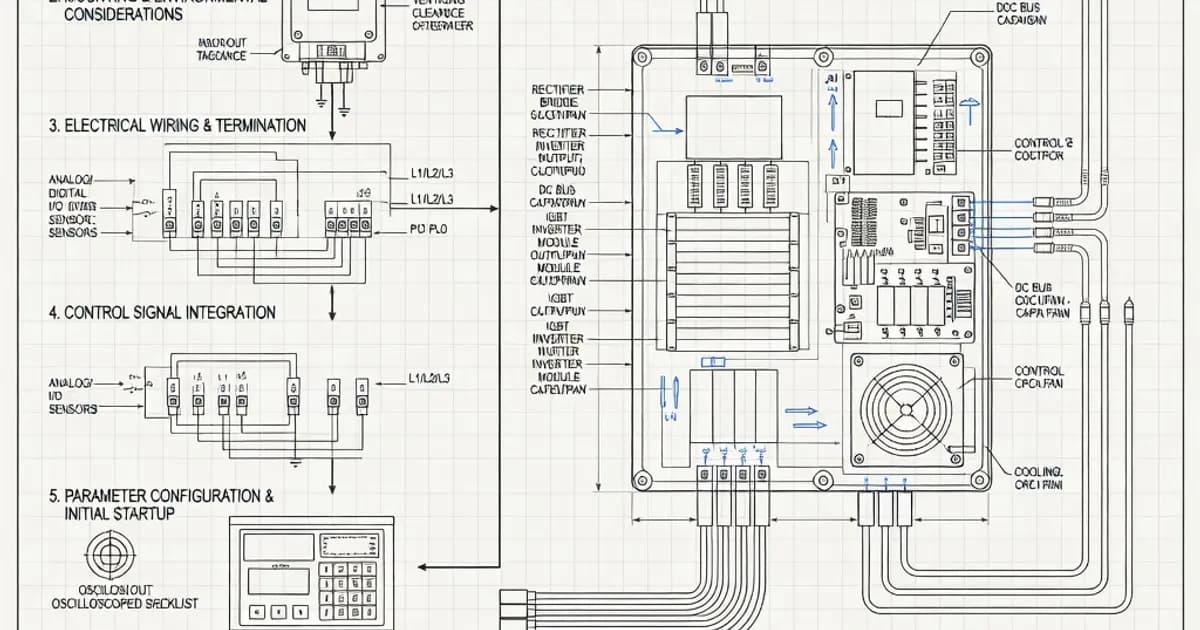
VFD Installation and Commissioning Guide
This guide outlines the essential steps for the installation and commissioning of Variable Frequency Drives (VFDs) to ensure optimal performance.
Introduction to VFDs
Variable Frequency Drives (VFDs) are used to control the speed and torque of electric motors by varying the frequency and voltage supplied to the motor. Proper installation and commissioning are crucial for optimal performance. VFDs must match motor nameplate ratings for voltage, frequency, current, and type (e.g., NEMA Design B induction motors); mismatch can cause damage or failure.
Pre-Installation Considerations
Before installing a VFD, consider the following:
- Check the motor specifications to ensure compatibility, including voltage and frequency ratings.
- Review the power supply requirements and ensure adequate capacity, as well as compliance with NEC (NFPA 70) standards for grounding and circuit protection.
- Assess the environmental conditions where the VFD will be installed, ensuring that the enclosure rating (e.g., IP66 for up to 11 kW) is appropriate for the installation site.
Installation Steps
The installation process typically involves:
- Mounting the VFD securely in a suitable location, ensuring proper airflow and compliance with NEMA standards for seismic mounting.
- Connecting input and output power cables according to the manufacturer's instructions, ensuring that cable lengths stay within manufacturer limits and using shielded cables earthed at both ends.
- Wiring control circuits and auxiliary devices, following IEC 60364 standards for wiring and earthing.
Commissioning the VFD
Once installed, commissioning involves:
- Configuring parameters such as motor speed and acceleration, with acceleration time set based on load inertia; for example, slow ramps for pumping applications to prevent water hammer.
- Testing the VFD operation under no-load conditions, starting with open-loop V/Hz control and verifying encoder/rotation.
- Verifying control signals and feedback from the motor, tuning velocity before full load, and ensuring compliance with UL standards for short-circuit protection.
Safety Considerations
Always follow safety guidelines during installation:
- Ensure power is disconnected before working on the VFD, and follow lockout/tagout procedures as per NEC guidelines.
- Use personal protective equipment (PPE) as necessary, especially when dealing with medium-voltage VFDs which require additional safety precautions.
- Follow lockout/tagout procedures, and ensure that all wiring is done in accordance with IEC and UL standards.
Conclusion
Proper installation and commissioning of VFDs are essential for maximizing their performance and lifespan. By following this guide, you can ensure a successful implementation while adhering to relevant standards such as IEC 60364 and IEEE guidelines for harmonics control.
References & Citations
- Step-by-step VFD Installation Guide — A comprehensive guide covering wiring, safety, parameter setting, and testing best practices for VFD installation.
- ABB Sample VFD Specification — Documentation detailing installation, UL/NEMA compliance, EMC, and commissioning services for ABB VFDs.
- Correct Commissioning of VSDs — An in-depth resource on VSD commissioning, including IEC 60364 wiring/earthing, parameter settings, and on-load tests.
- Commissioning a VFD: Variable Frequency Drive — An article outlining the commissioning timeline and checklist for medium-voltage VFDs, including preparation and pre-energization steps.
- Government Specification for VFD Installation — A specification document for VFD installation and commissioning per NEC/NEMA/IEC/UL standards, including seismic mounting and start-up verification.
Need help selecting the right component?
Related Categories
Frequently Asked Questions
Looking for a specific product?
Our team can help you find the right electrical components for your project.