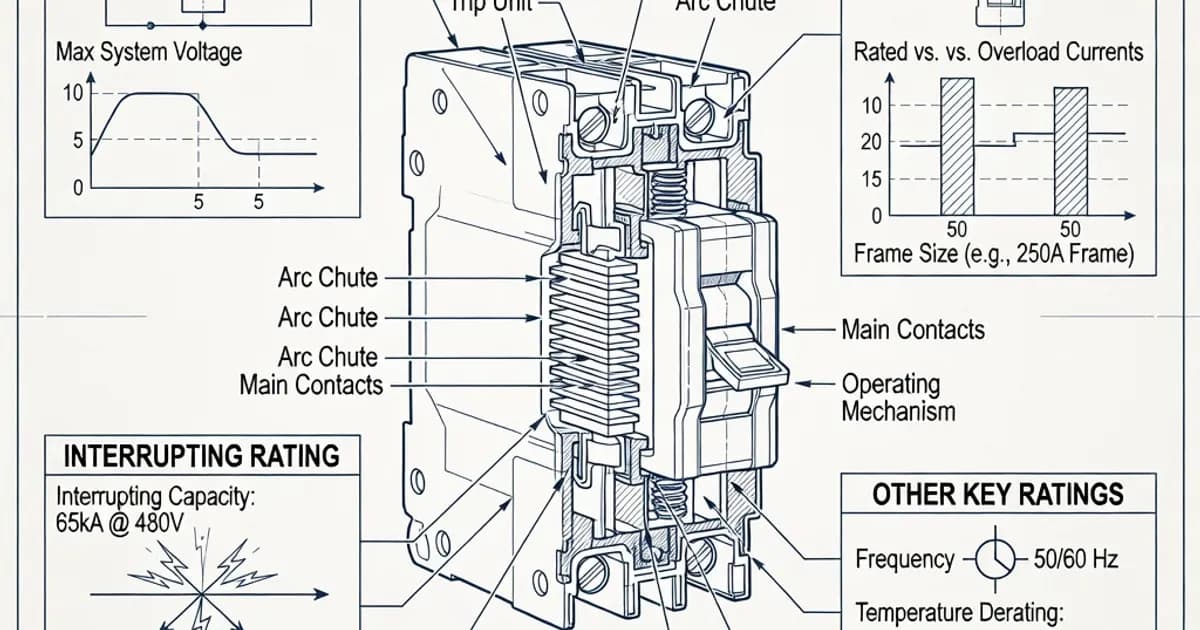
Understanding Circuit Breaker Ratings
This article delves into the various ratings of circuit breakers, explaining their significance in electrical systems. Learn how to choose the right breaker for your application.
Introduction to Circuit Breaker Ratings
Circuit breakers are essential components of electrical systems, designed to protect circuits from overloads and short circuits. Understanding their ratings is crucial for ensuring safety and reliability. The key ratings include voltage, current, and interrupting capacity. Circuit breakers have maximum voltage ratings ranging from 4.76 kV to 800 kV for high-voltage types above 1000 V AC, covering both indoor and outdoor applications.
Voltage Rating
The voltage rating of a circuit breaker indicates the maximum voltage it can handle without the risk of arcing or failure. It's essential to select a breaker with a voltage rating that exceeds the highest voltage in your system, complying with IEC 60947-2 standards. High-voltage circuit breakers are designed to handle voltages up to 800 kV, ensuring they can safely operate in demanding environments.
Current Rating
The current rating, often denoted in amperes (A), defines the maximum continuous current the breaker can carry without tripping. Selecting the appropriate current rating involves considering the load and ensuring compliance with NEC Article 240. Continuous current ratings for high-voltage breakers typically include 600 A, 1200 A, 2000 A, 3000 A, and 4000 A, matched to specific voltage levels. For low-voltage molded case circuit breakers (MCCBs), ampere ratings range from 15 A up to several thousand amperes, determined by thermal and magnetic trip mechanisms for overload and short-circuit protection.
Interrupting Capacity
Interrupting capacity is the maximum fault current the breaker can interrupt safely. This rating is crucial for protecting equipment and personnel. It's vital to choose a breaker with an interrupting capacity that exceeds potential fault currents in the system, in line with IEEE Std 141. For industrial circuit breakers, the interrupting capacity (Icu) is the maximum rms short-circuit current (in kA) the breaker can interrupt without damage, while domestic types use Icn. Branch circuit breakers must have interrupting ratings marked unless exceeding 5000 A (NEC 240.83).
Choosing the Right Breaker
When selecting a circuit breaker, consider the application, load type, and environmental conditions. For instance, residential applications may require different specifications compared to industrial setups. Always refer to local codes and standards when making your selection. It's recommended to use 80%-rated breakers for continuous loads in North America, limiting loads to 80% of the rating, while 100%-rated breakers (per IEC standards) allow up to 100%. Ensure that all devices in a system have interrupting ratings equal to or greater than the available short-circuit current (NEC 110.9).
| Parameter | Description |
|---|---|
| Voltage Rating | Maximum voltage the breaker can handle, ranging from 4.76 kV to 800 kV for high-voltage types. |
| Current Rating | Maximum continuous current capacity, with high-voltage ratings including 600 A to 4000 A. |
| Interrupting Capacity | Maximum fault current the breaker can interrupt, with industrial types rated for specific kA levels. |
Conclusion
Understanding the ratings of circuit breakers is vital for ensuring the safety and functionality of electrical systems. By adhering to relevant standards and selecting the correct ratings, you can prevent equipment damage and enhance system reliability. Proper selection based on application and compliance with standards like NEC and IEC can significantly improve the performance and safety of electrical installations.
References & Citations
- IEEE C37.04-2018 — Standard for Ratings and Requirements for AC High-Voltage Circuit Breakers with Rated Maximum Voltage Above 1000 V.
- Eaton Technical Guide — Guide on applying interrupting ratings, series vs. fully rated systems, and NEC compliance.
- Schneider Electric Wiki — Details fundamental characteristics of circuit breakers per IEC 60947-2.
- ABB Whitepaper — Explains power circuit breaker ratings, including short-time currents per ANSI/UL standards.
- Rockwell Automation Guide — Guide on selecting 80% vs. 100%-rated MCCBs with NEC references.
Need help selecting the right component?
Related Categories
Frequently Asked Questions
Looking for a specific product?
Our team can help you find the right electrical components for your project.