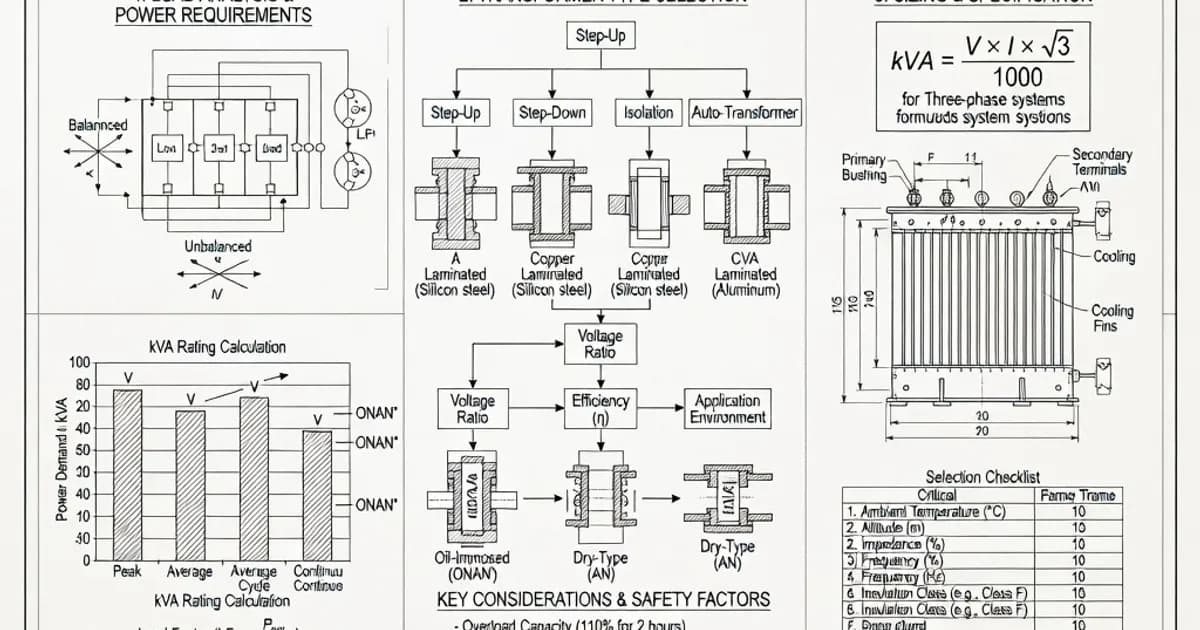
Transformer Sizing and Selection Basics
This article outlines the fundamental principles of transformer sizing and selection, including key factors and calculations necessary for optimal performance.
Understanding Transformers
Transformers are critical components in electrical systems, used to step up or step down voltage levels for efficient power distribution. Proper sizing and selection are crucial to ensure they operate effectively and meet system requirements. Transformer sizing typically requires a growth factor of 110% to 130% above calculated load to account for future expansion and facility modifications.
Key Factors in Transformer Sizing
Several key factors must be considered when sizing a transformer:
- **Load Requirements**: Determine the total load in kilowatts (kW) to ensure the transformer can handle the demand. For mixed single/three-phase loads, base kVA on the largest load per phase winding.
- **Voltage Levels**: Identify the primary and secondary voltage levels needed for the application.
- **Phase Type**: Decide whether a single-phase or three-phase transformer is required based on the system design.
Calculating Transformer Size
The formula for calculating transformer size is:
Transformer Size (kVA) = Total Load (kW) / Power Factor
Where the power factor is typically between 0.8 to 1.0 for most applications. For example, if the total load is 100 kW with a power factor of 0.9, then:
Transformer Size = 100 kW / 0.9 = 111.11 kVA. Standard commercial transformer sizes include 75 kVA, 300 kVA, 500 kVA, 750 kVA, and 1,000 kVA, selected as the next standard rating above calculated needs (e.g., 52.5 kVA load requires 75 kVA).
Selection Criteria
When selecting a transformer, consider the following criteria:
- **Efficiency**: Look for transformers with high efficiency ratings to minimize energy losses. The DOE sets minimum efficiency levels that must be met for new units, such as TP1, TP2, and TP3 classes.
- **Cooling Method**: Choose between air-cooled or oil-cooled transformers based on environmental conditions and installation space. For transformers rated between 75-500 kVA, a concrete pad of 5.5 ft × 6.5 ft × 10 in thick is recommended.
- **Standards Compliance**: Ensure the transformer meets relevant standards, such as IEEE C57.12.00 and IEC 60076. For nonlinear loads with more than 15% total harmonic distortion (THD), select K-factor rated transformers (per ANSI/IEEE C57.110) to handle extra heat without derating.
Transformer Types
There are several types of transformers available:
- **Power Transformers**: Used in transmission networks for high voltage applications.
- **Distribution Transformers**: Used to supply power to residential and commercial areas.
- **Isolation Transformers**: Provide electrical isolation between circuits for safety.
Conclusion
Correctly sizing and selecting a transformer is essential for the efficiency and reliability of electrical systems. By understanding the key factors and calculations involved, engineers can make informed decisions that enhance performance and safety. It is also crucial to derate transformer kVA by 8% for each 10°C above 40°C in high ambient temperatures to ensure optimal operation.
References & Citations
- IEEE C57.110-2018 — IEEE Recommended Practice for Establishing Liquid-Filled and Dry-Type Power and Distribution Transformer Capability when Supplying Nonsinusoidal Load Currents; covers K-factor ratings and derating for harmonic loads.
- IEC 60076-1:2011 — Power transformers - Part 1: General; covers general requirements including ratings, voltage levels, and cooling methods for international sizing.
- How to Correctly Size a Transformer — Consulting-Specifying Engineer article on practical sizing methods, derating, and growth factors with examples and tables.
- Sizing Transformers — Dongan Electric PDF guide with kVA formulas, HP charts, and derating for industrial applications.
- Transformer Sizing Guide — Electrical Engineering Portal guide on nameplate parameters and design basics for transformer sizing.
Need help selecting the right component?
Related Categories
Frequently Asked Questions
Looking for a specific product?
Our team can help you find the right electrical components for your project.