Sensor Types in Industrial Automation
Explore various sensor types used in industrial automation, their applications, and selection criteria to optimize system performance.
Introduction to Industrial Sensors
Sensors are vital components in industrial automation systems, providing critical data for process control and monitoring. Understanding different sensor types and their applications is essential for optimizing system performance. This article explores common sensor types used in industrial settings. Industrial sensors typically operate using standardized output ranges including 0-10V, 0-5V, 0-24V, and 4-20 mA current loops, where 4 mA represents the low signal and 20 mA represents the high signal in analog systems.
Types of Sensors
Sensors can be categorized based on their operating principle and application. Here are some common sensor types:
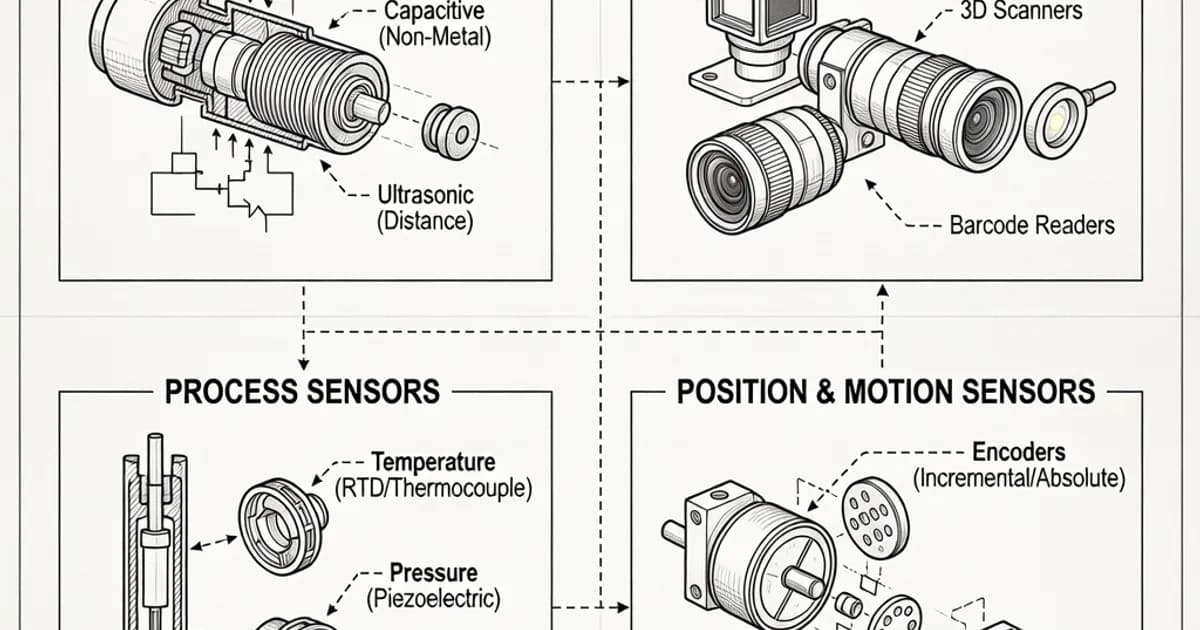
- Proximity Sensors: Detect the presence or absence of an object without physical contact. Types include inductive, capacitive, and ultrasonic sensors. Capacitive proximity sensors operate with sensing ranges up to several tens of millimeters and work with both metallic objects and dielectric materials such as resins, liquids, and powders.
- Temperature Sensors: Measure temperature and can be thermocouples, RTDs, or thermistors. Silicon-based digital temperature sensors provide accurate output through digital representations, simplifying control system design compared to approaches requiring external signal conditioning and analog-to-digital converters (ADCs).
- Pressure Sensors: Measure pressure in gases or liquids, commonly used in process control. These sensors can be classified into electrical, thermal, and mechanical types, depending on the signal processing method.
- Flow Sensors: Measure the flow rate of liquids or gases in pipes. They are essential for monitoring and controlling fluid dynamics in various industrial processes.
- Level Sensors: Detect the level of fluids in tanks and vessels, using technologies like float, capacitive, ultrasonic, or radar. Continuous-level sensors have become more popular in the 2020s because they provide more granular data compared to point-level sensors that only indicate when a substance reaches a certain amount.
Selection Criteria for Sensors
When selecting sensors for industrial applications, consider factors such as:
- Environment: Determine the operating conditions, including temperature, humidity, and potential exposure to chemicals. Select certified sensors for harsh and hazardous environments where sensors may be exposed to explosive atmospheres, extreme temperatures, high vibration levels, mechanical shock, or strong EMI/RFI/ESD fields.
- Accuracy: Evaluate the required accuracy for the specific application. For instance, the accuracy of pressure sensors can vary significantly based on the technology used.
- Response Time: Select sensors with an appropriate response time for the application requirements. Digital sensors often have faster response times compared to their analog counterparts.
Table of Common Sensor Types
| Sensor Type | Application |
|---|---|
| Proximity Sensor | Object detection |
| Temperature Sensor | Temperature monitoring |
| Pressure Sensor | Pressure measurement |
| Flow Sensor | Flow rate measurement |
| Level Sensor | Fluid level detection |
Conclusion
Choosing the right sensor type for an industrial automation application is crucial for accurate data collection and process control. Familiarity with various sensor types and their characteristics can enhance system efficiency. Additionally, modern automation systems increasingly use digital outputs (NPN/PNP switches, USB, wireless interfaces) alongside traditional 4-20 mA current loops for improved integration and performance.
References & Citations
- Types of Sensors Used in Industrial Automation — Comprehensive overview of temperature sensors, pressure sensors, MEMS sensors, and torque transducers with detailed application examples.
- Sensor Types — Major sensor manufacturer providing specifications for digital sensors, wireless connectivity options, and sensors for harsh environments.
- Introduction to Industrial Sensors — Technical classification of industrial sensors by signal type with standard output ranges and process control applications.
- Types of Sensors: A Complete Guide — Detailed guide covering proximity sensors, level sensors, and key specifications for sensor selection in industrial applications.
- Understanding Sensors for Motion Control and Manufacturing — Industry insights on encoder technologies, proximity sensing methods, and condition monitoring sensor applications.
Need help selecting the right component?
Related Categories
Frequently Asked Questions
Looking for a specific product?
Our team can help you find the right electrical components for your project.