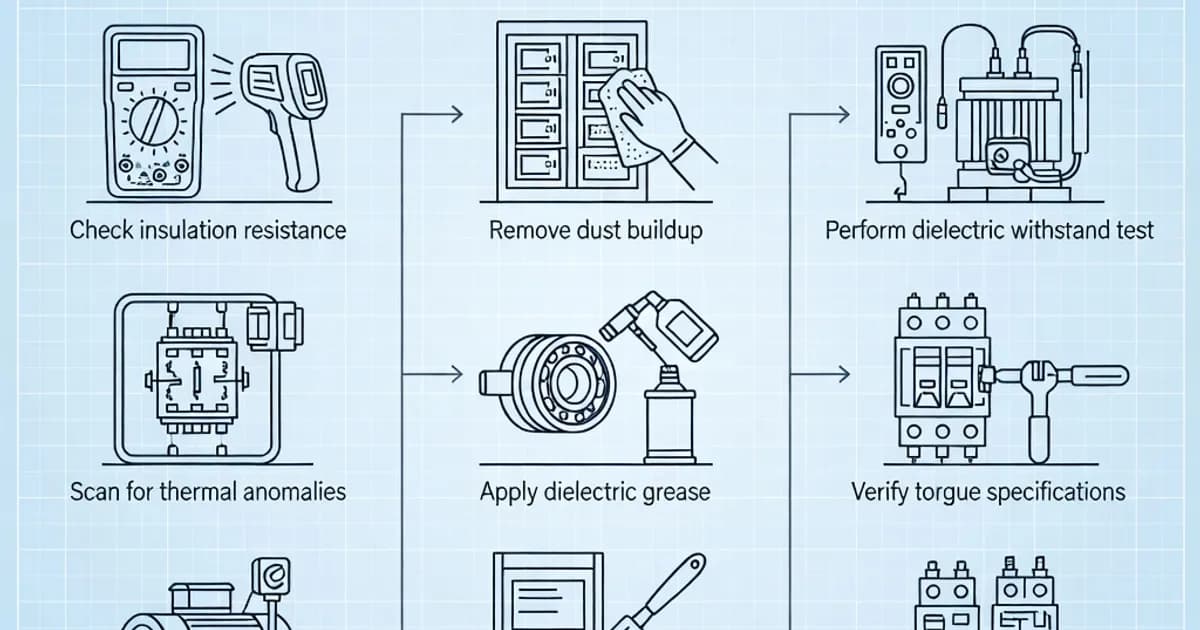
Preventive Maintenance for Electrical Equipment
This article explains the importance of preventive maintenance for electrical equipment, outlining best practices and maintenance schedules to enhance reliability.
Importance of Preventive Maintenance
Preventive maintenance is crucial for ensuring the reliability and longevity of electrical equipment. Regular maintenance can prevent unexpected failures, reduce downtime, and improve overall system performance. In fact, more than two-thirds of electrical system failures can be prevented by a routine preventive maintenance program, as failure rates are three times higher for components without scheduled maintenance.
Key Components of Preventive Maintenance
Effective preventive maintenance includes the following key components:
- **Routine Inspections**: Regular checks of equipment to identify signs of wear and tear. Organizations using preventive maintenance report 52.7% less unplanned downtime, which is critical given that manufacturers face average downtime costs of $125,000 per hour.
- **Testing and Calibration**: Ensuring equipment operates within specified parameters for optimal performance. For instance, infrared thermographic inspections, recommended every 3 years, can identify loose connections, overloads, and imbalances, significantly reducing failures in switchgear, panels, and motor controls.
- **Cleaning**: Keeping equipment free from dust and debris to prevent overheating and malfunctions. Regular cleaning is emphasized in guidelines from manufacturers such as Siemens, which recommends quarterly cleaning for MCCs in dusty environments.
Maintenance Schedules
Establishing a maintenance schedule is vital for effective preventive maintenance. Consider the following guidelines:
- **Frequency of Use**: Equipment used more frequently may require more regular maintenance. For example, ABB recommends annual visual inspections and torque checks on connections for LV/MV switchgear.
- **Manufacturer Recommendations**: Follow guidelines provided by equipment manufacturers for maintenance intervals. Schneider Electric advises monthly log reviews for circuit breakers and annual contact resistance tests.
- **Environmental Factors**: Equipment in harsh environments may need more frequent inspections and maintenance. According to IEC 60364-6, preventive checks for continuity and insulation resistance should be performed every 1-3 years based on the environment.
Documentation and Record Keeping
Keeping detailed records of maintenance activities is essential for tracking equipment performance and schedules. Proper documentation helps in planning future maintenance and provides valuable information for audits. Following standards such as NFPA 70B can guide organizations in developing effective maintenance programs, including detailed recordkeeping for switchgear, transformers, and motors.
Compliance with Standards
Adhering to standards such as NFPA 70B can guide organizations in developing effective maintenance programs. This standard outlines best practices for electrical equipment maintenance, including inspection frequencies and testing procedures like infrared thermography. Compliance with standards can yield significant benefits, as predictive enhancements to preventive programs can yield 8-10x ROI and reduce emergency callouts by 60%.
Conclusion
Preventive maintenance is a proactive approach that can significantly enhance the reliability and efficiency of electrical equipment. By implementing a comprehensive maintenance program, organizations can reduce costs by 53% over five years in a typical 100,000 sq ft facility, improving operational performance and extending equipment life by 10-15% or even 20-40% with predictive integration.
References & Citations
- IEEE 3007.2 - Recommended Practice for Maintenance of Industrial and Commercial Power Systems — Details maintenance tasks, schedules, and testing for power distribution systems to ensure reliability and prevent failures.
- NFPA 70B - Recommended Practice for Electrical Equipment Maintenance — Provides comprehensive guidelines for preventive maintenance programs on industrial electrical equipment, including inspection frequencies and testing procedures.
- ABB Electrical Equipment Maintenance Services — Offers downloadable guides for switchgear and transformers, including frequency recommendations for maintenance activities.
- Siemens Low-Voltage Maintenance Documentation — Covers best practices for panels and MCCs with thermography protocols and maintenance guidelines.
- Electrical Preventive Maintenance (EPM) — An article discussing EPM programs with references to NFPA 70B, infrared testing, and real-world implementation statistics from industry sources.
Need help selecting the right component?
Related Categories
Frequently Asked Questions
Looking for a specific product?
Our team can help you find the right electrical components for your project.