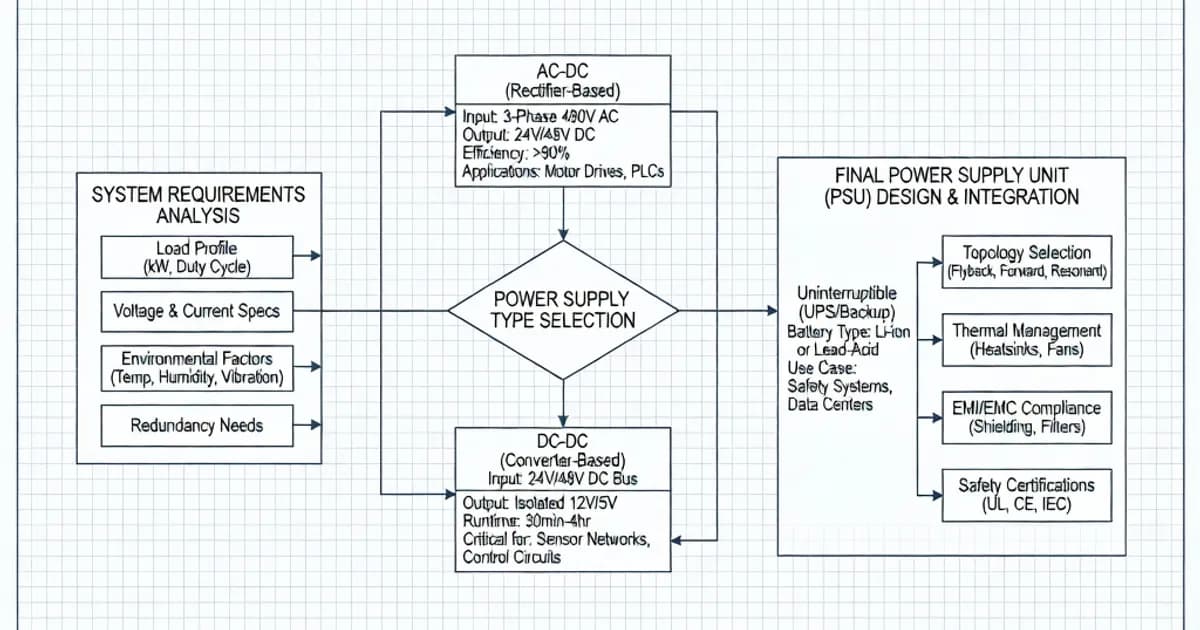
Power Supply Selection for Industrial Systems
Learn how to select the right power supply for industrial systems, considering factors like load requirements, efficiency, and safety standards.
Introduction to Power Supply Selection
Choosing the right power supply is crucial for the performance and reliability of industrial systems. A well-selected power supply ensures adequate voltage and current for equipment operation while meeting safety and efficiency standards. Industrial power supplies must be sized with 20-50% headroom above peak load current to handle inrush currents, temperature derating, and transients, ensuring reliability in harsh environments. This article will discuss key considerations for selecting power supplies in industrial applications.
Understanding Load Requirements
The first step in selecting a power supply is understanding the load requirements of the system. Calculate the total power consumption by summing the wattage of all connected devices. Ensure that the chosen power supply can provide at least 20-50% more capacity than the total load to accommodate inrush currents and future expansion. Additionally, consider the maximum output limits set by standards such as UL 1310, which restricts Class 2 power supplies to 60 VDC/30 VAC output and a maximum of 5 A to minimize fire and shock risks.
Efficiency and Power Factor
Efficiency is a critical factor in power supply selection, as it impacts energy consumption and operational costs. Look for power supplies with a high efficiency rating (above 85%) to minimize losses. Efficiency standards target >90% for industrial supplies under IEC 62368-1 to reduce heat and energy loss, with derating curves showing 20-30% capacity loss at 50°C ambient. Additionally, consider the power factor, which indicates how effectively the power supply converts electrical power into useful work. A power factor close to 1 is desirable, and active power factor correction (PFC) is recommended for improved efficiency.
Safety Standards and Certifications
Ensure that the power supply complies with relevant safety standards such as UL, CE, and IEC 60950. Compliance with these standards ensures that the equipment is safe to operate and reduces liability. Notably, IEC 62368-1 mandates hazard-based safety engineering, replacing IEC 60950-1, with dielectric strength tests up to 4000 VAC for double insulation in medical-industrial hybrids. Furthermore, UL 508 requires industrial control equipment, including power supplies, to pass enclosure integrity tests for IP ratings up to IP67 in dusty/wet industrial settings.
Table of Power Supply Selection Criteria
| Criteria | Description |
|---|---|
| Load Requirements | Power consumption of connected devices, with a recommendation for 20-50% oversizing for reliability. |
| Efficiency | Ratio of output power to input power, targeting >90% efficiency under IEC 62368-1. |
| Power Factor | Effectiveness of power usage, with a preference for active PFC (>0.95). |
| Safety Standards | Compliance with industry regulations, including UL 508 and IEC 62368-1. |
Conclusion
Selecting the appropriate power supply for industrial systems is essential for operational reliability and efficiency. By considering load requirements, efficiency, and safety standards, engineers can make informed decisions that enhance system performance. Manufacturer recommendations suggest prioritizing DIN-rail mounting and ensuring compliance with relevant standards like UL 508A for industrial control panels to ensure safe integration.
References & Citations
- UL Solutions - Power Supply Testing and Certification — Official page detailing IEC 62368-1 and UL 508 paths for industrial compliance.
- Industrial Power Supplies Guide - c3controls — White paper on industrial power supply selection, types, specs, and regulatory standards.
- Understanding Codes and Standards - Eaton — Video overview of NEC, IEC, and IEEE standards for power systems design in industrial applications.
- Power Supply Safety Standards - Volgen — Technical article on IEC 62368-1 and UL 508 safety standards for power supplies.
- Power Supply Safety Standards - Bel Fuse — Technical paper on power supply safety marks, including UL 1310 and IEC 62368-1.
Need help selecting the right component?
Related Categories
Frequently Asked Questions
Looking for a specific product?
Our team can help you find the right electrical components for your project.