PLC Programming Basics for Beginners
This article introduces the fundamentals of PLC programming, covering basic concepts, languages, and practical examples for new users.
Introduction to PLCs
Programmable Logic Controllers (PLCs) are essential in industrial automation, enabling control of machinery and processes. Understanding the basics of PLC programming is crucial for anyone looking to enter this field. This article will guide beginners through the fundamental concepts and programming languages used in PLCs. As of 2023, the industrial automation and control systems market is projected to grow from US$210.83 billion in 2025 to US$466.29 billion by 2034, reflecting the increasing reliance on PLC technology.
What is a PLC?
A PLC is a digital computer designed for industrial applications. It can be programmed to perform various control functions, making it versatile in automating processes. PLCs are designed to withstand harsh environments and can be programmed using different languages, including ladder logic, function block diagrams, and structured text. Modern PLCs can handle hundreds of instructions in a single compact device, significantly simplifying modifications and testing compared to traditional relay-based control systems.
PLC Programming Languages
PLC programming languages are standardized by the IEC 61131-3 standard. The most commonly used languages include:
- Ladder Logic: Resembles electrical relay logic diagrams and is widely used for its simplicity. It is particularly effective for beginners due to its visual nature.
- Structured Text: A high-level programming language similar to Pascal, suitable for complex calculations. It is ideal for tasks that require advanced data handling.
- Function Block Diagram: Represents functions using blocks and is suitable for visual programming. This language is often used in conjunction with SCADA systems for real-time monitoring.
Basic PLC Programming Concepts
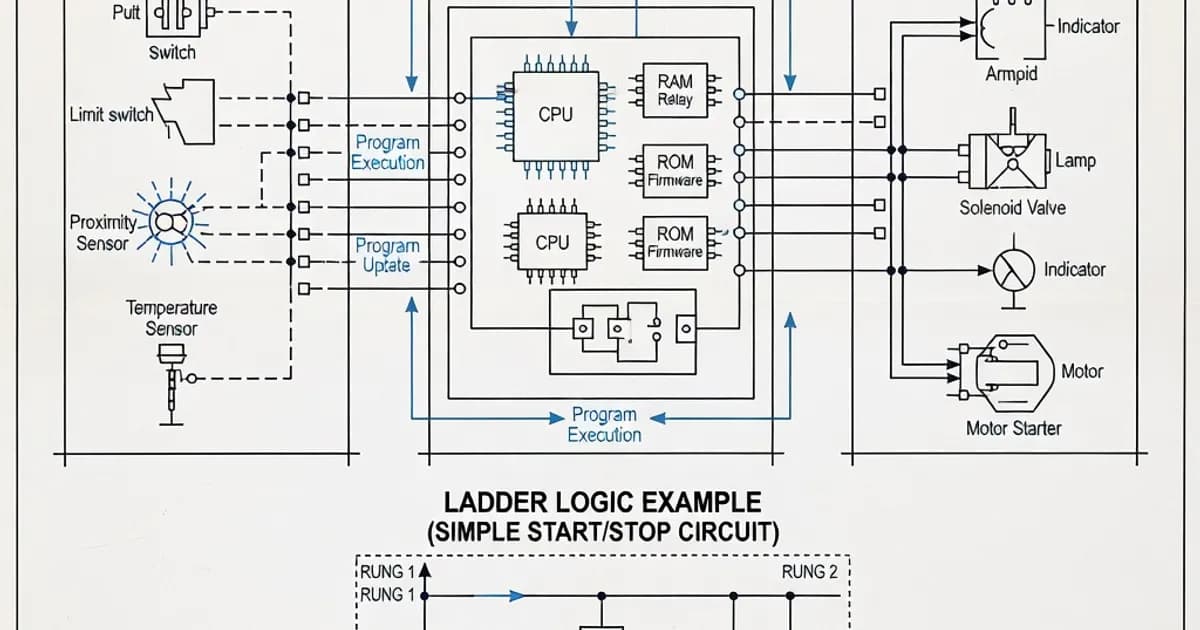
Key concepts in PLC programming include inputs, outputs, and scanning cycles. Inputs are signals from sensors or switches, while outputs control actuators like motors and valves. The PLC continuously scans the inputs, executes the program logic, and updates the outputs in a cyclic manner. This core operating cycle allows for real-time adjustments to industrial processes, ensuring optimal performance and efficiency.
Example of a Simple Ladder Logic Program
Consider a simple ladder logic program that controls a motor based on a start and stop push button:
-----[ ]----[ ]-----
| Start |  | Stop |  | Motor |
---------------------
This program turns on the motor when the start button is pressed and keeps it running until the stop button is pressed. Such basic programs are foundational for understanding more complex applications, especially as PLCs increasingly incorporate AI capabilities to enhance operational efficiency.
Conclusion
PLC programming is a powerful skill in industrial automation. By understanding the basics and practicing with simple programs, beginners can develop the skills necessary for more complex applications. With the integration of AI, PLCs are projected to reduce downtime by up to 40% and improve process quality by 15–20% by 2026, making proficiency in PLC programming even more valuable.
References & Citations
- PLC Programming and Automation Services — Covers PLC programming fundamentals, how PLCs process inputs and outputs, and the role of professional PLC programmers in industrial automation.
- PLCs and Their Future in the Industry in 2025 — Provides current market data on Ethernet-based protocols, SCADA integration statistics, AI-enhanced PLC capabilities, and financial impact studies from Rockwell Automation and McKinsey.
- The Future of PLC Programming: Trends and Innovations — Details emerging trends including IoT integration, Industry 4.0 adoption, wireless communication, and AI/machine learning integration in PLC systems.
- How PLC Programming Powers Automated Systems — Explains the evolution from relay-based systems to digital logic, the PLC control loop, and real-world applications in manufacturing.
- Data Modeling in Industrial Automation — Discusses advanced data modeling techniques using OPC UA and the evolution of data handling in industrial automation systems.
Need help selecting the right component?
Related Categories
Frequently Asked Questions
Looking for a specific product?
Our team can help you find the right electrical components for your project.