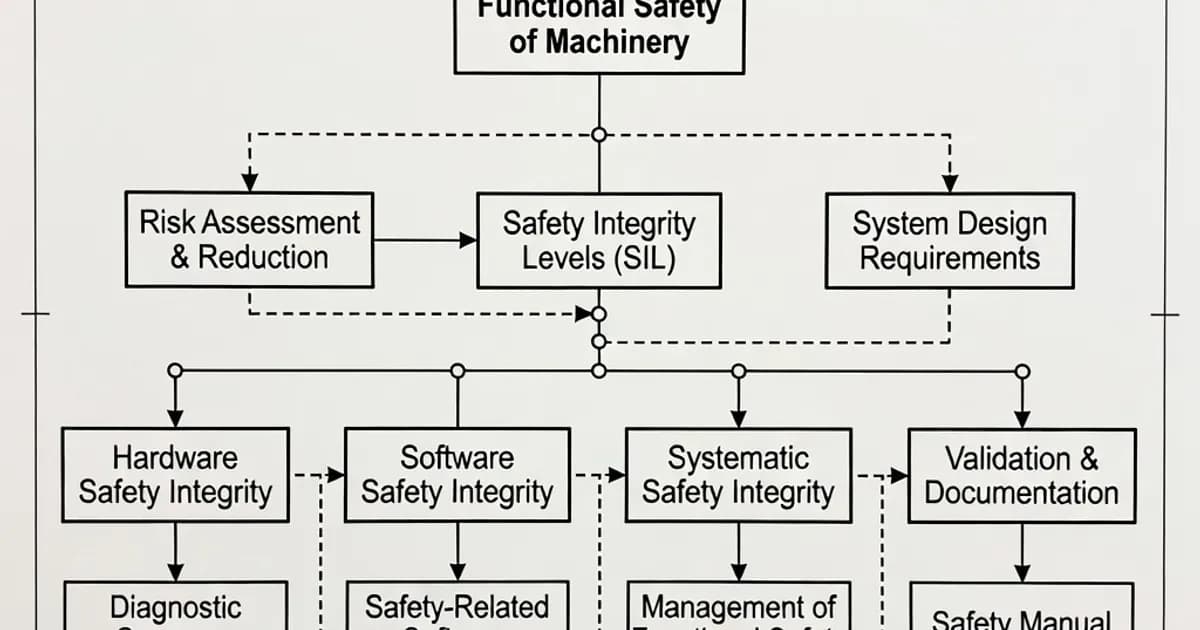
Industrial Safety Standards Overview (IEC 62061)
This article provides an overview of IEC 62061, detailing its importance in safety-related control systems in industrial applications. Understand the framework and requirements for functional safety.
Introduction to IEC 62061
IEC 62061 is an international standard that provides a framework for ensuring the safety of machinery through safety-related control systems (SCS). It is essential for industries that require functional safety to mitigate risks associated with machinery operation. The 2021 edition extends coverage beyond electrical systems to include non-electrical technologies such as mechanical, pneumatic, and hydraulic systems, ensuring a comprehensive approach to safety across various machine types.
Understanding Functional Safety
Functional safety is defined as the part of the overall safety that depends on a system or equipment operating correctly in response to its inputs. IEC 62061 emphasizes the importance of safety lifecycle processes, which include hazard analysis, risk assessment, and verification. This standard applies to non-portable machines or coordinated machine groups and covers the full lifecycle from concept to decommissioning, emphasizing high-demand and continuous demand safety systems.
Key Elements of IEC 62061
The standard outlines several key elements that organizations should implement, including:
- Risk Assessment: Analyzing potential hazards and their consequences, utilizing parameters such as severity of injury (Se), frequency/duration of exposure (Fr), likelihood of hazardous events (Pr), and avoidability of damage (Av).
- Safety Requirements Specification: Documenting safety functions and performance levels, which must detail machine cycle time, response time, environmental conditions, and man-machine interactions.
- Verification and Validation: Ensuring safety requirements are met through testing and analysis, including periodic testing as mandated in Clause 6.9 of the 2021 edition.
Safety Integrity Levels (SIL)
IEC 62061 defines Safety Integrity Levels (SIL), which categorize the required safety performance of safety-related systems. The four levels of SIL range from SIL 1 (lowest) to SIL 4 (highest). Each level corresponds to a different level of risk reduction necessary for safety functions. For instance, SIL 1 requires a probability of dangerous failure per hour (PFHD) of ≥10⁻⁶ to <10⁻⁵, while SIL 4 requires a PFHD of ≥10⁻⁴ to <10⁻³, reflecting the critical nature of safety functions at higher levels.
Compliance with IEC 62061
To ensure compliance with IEC 62061, organizations should integrate safety into their design and operational processes. Regular audits and assessments can help maintain adherence to the standard. Manufacturers like Pilz recommend a full lifecycle implementation, emphasizing the integration of all technologies and sector-specific SIL for electrical/electronic/programmable systems in high-demand machinery environments.
| SIL Level | Risk Reduction Factor |
|---|---|
| SIL 1 | 10 to 100 (PFHD ≥10⁻⁶ to <10⁻⁵) |
| SIL 2 | 100 to 1,000 (PFHD ≥10⁻⁷ to <10⁻⁶) |
| SIL 3 | 1,000 to 10,000 (PFHD ≥10⁻⁸ to <10⁻⁷) |
| SIL 4 | 10,000 to 100,000 (PFHD ≥10⁻⁴ to <10⁻³) |
Conclusion
By adhering to IEC 62061, organizations can significantly enhance the safety of their machinery and protect employees from potential hazards. Continuous education and training on this standard are crucial for maintaining safety in industrial environments. Incorporating recommendations from manufacturers such as Phoenix Contact can further improve compliance through detailed assessments of mechanical, pneumatic, and hydraulic systems, ensuring all aspects of safety are addressed.
References & Citations
- IEC 62061:2021 — Official IEC page for IEC 62061:2021; details scope, technical changes, and purchase for full standard text.
- Phoenix Contact Technical Update on EN IEC 62061 — Covers key changes in the IEC 62061 revisions, including non-electrical extensions and annexes.
- Pilz Overview of IEC 62061 — Explains the lifecycle and 2021 updates of IEC 62061 as sector-specific under IEC 61508.
- ANSI Blog on IEC 62061 Ed. 2.0 b:2021 — Summarizes applicability and changes for machinery designers regarding IEC 62061 and its amendments.
- Unique Safety Products Guide on IEC 62061 — Provides SIL tables, PFHD ranges, SFF matrices, and risk parameters related to IEC 62061.
Need help selecting the right component?
Related Categories
Frequently Asked Questions
Looking for a specific product?
Our team can help you find the right electrical components for your project.