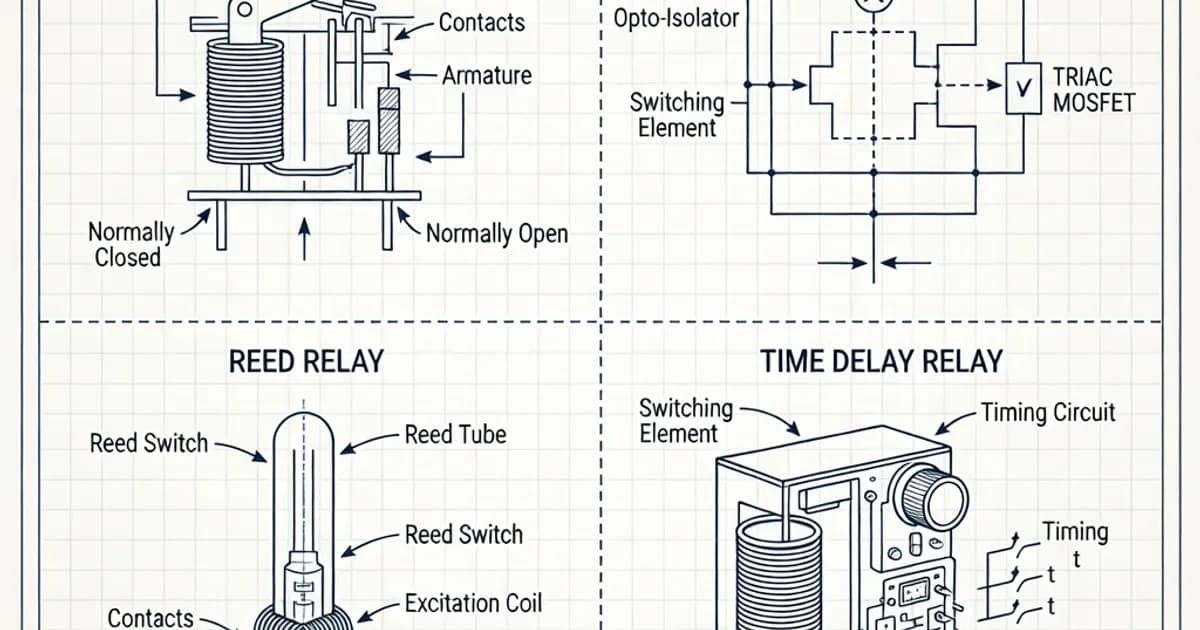
Industrial Relay Types Explained
This article provides an overview of various types of industrial relays and their applications. Understand how to choose the right relay for your needs.
Introduction to Industrial Relays
Industrial relays are crucial components in automation and control systems, acting as switches that open or close circuits based on an input signal. Understanding the different types of relays is essential for effective application. Industrial relays typically have contact ratings of 10A at 250VAC or 10A at 24VDC, with maximum carrying currents up to 14A.
Electromechanical Relays
Electromechanical relays use an electromagnetic coil to operate a switch. They are reliable and widely used for switching applications, but they may have slower response times compared to solid-state relays. Coil power consumption ranges from 530mW (high-sensitivity types) to 700-750mW (standard types), with operate power around 350-370mW. Mechanical life exceeds 20 x 10^6 operations (AC) or 50 x 10^6 (DC), with operating temperatures up to 105°C for high-ambient versions.
Solid-State Relays (SSRs)
Solid-state relays provide faster switching capabilities and longer life spans due to their lack of moving parts. They are ideal for high-speed applications and are commonly used in modern automation systems. Unlike electromechanical relays, SSRs can achieve switching frequencies of up to 3600 operations/hour, making them suitable for applications requiring high-speed performance.
Time Delay Relays
Time delay relays introduce a delay before the circuit is activated or deactivated. They are useful in applications requiring precise timing, such as motor start/stop sequences. Typical pickup and dropout times for these relays are around 12ms, which can enhance the reliability of operations in automated systems.
Choosing the Right Relay
Selecting the appropriate relay involves considering the load type, control voltage, and switching capacity. Always refer to IEC 61810 for specifications on relay types and applications. Ensure that the voltage ratings for industrial relays commonly include 12VDC, 24VDC, 48VDC, 120VAC, and 240VAC, where contact-side ratings must exceed load voltage. It is also advisable to match NEMA pilot duty ratings (e.g., B300) to load requirements for optimal performance.
| Relay Type | Description |
|---|---|
| Electromechanical Relay | Uses an electromagnetic coil for switching. Typical contact materials include AgCdO and AgSnO2, supporting NEMA pilot duties like B300 for AC/DC switching up to 35-40A at 277VAC. |
| Solid-State Relay | No moving parts, faster switching. Ideal for applications requiring high switching frequencies. |
| Time Delay Relay | Introduces a delay before activation. Useful for precise timing in automation. |
Conclusion
Understanding the types of industrial relays and their applications is critical for effective circuit control. By following guidelines and standards, such as IEC 60335-1 for safety and EN 50205 for force-guided relays, you can select the right relay for your needs. Additionally, consider using relays with mechanical life ratings exceeding 20M operations for applications requiring frequent cycling.
References & Citations
- IEC 60335-1 — Details safety requirements for household and similar electrical appliances, including WG-type relays for reinforced insulation.
- IEEE C37.90/UL 508 — Covers industrial relay testing and ratings, providing standards for safety and performance.
- Eaton Control Relays and Timers Datasheet — Specifications on XR-series plug-in relays, including IP67 protection and cULus certifications.
- Rockwell Automation Relay and Timer Specifications — Includes mechanical life, NEMA ratings, and voltage data for various relay types.
- EEP Relay Guide — A reputable industry resource on types, specifications, and selection criteria for industrial relays.
Need help selecting the right component?
Related Categories
Frequently Asked Questions
Looking for a specific product?
Our team can help you find the right electrical components for your project.