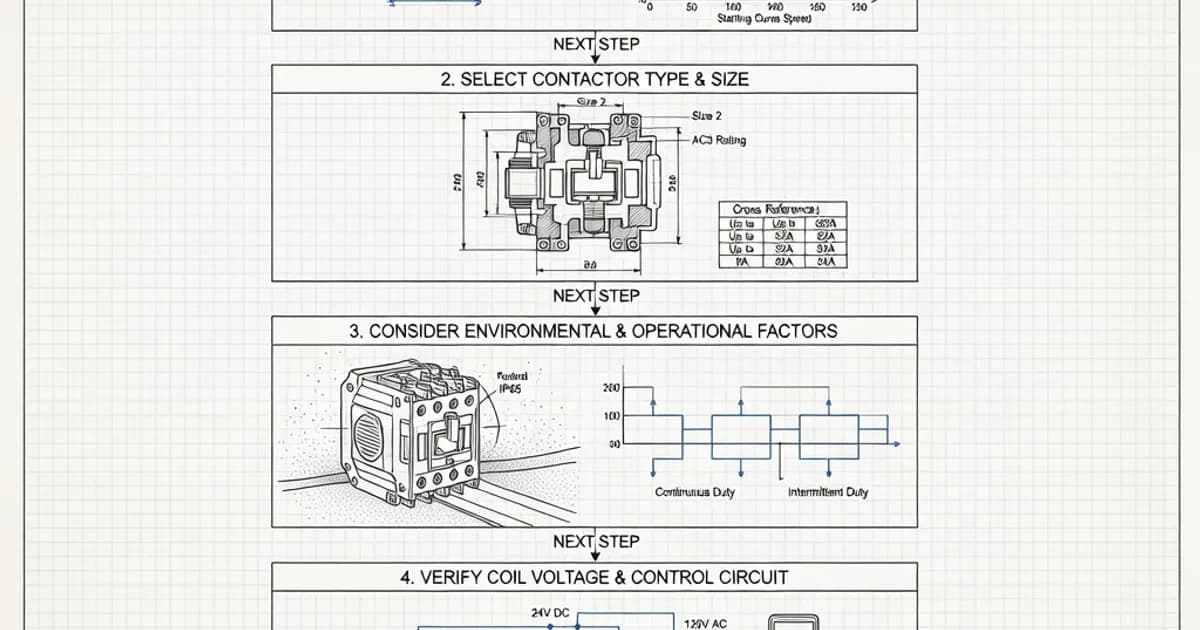
How to Select the Right Contactor
Selecting the right contactor is crucial for motor control applications. This guide outlines factors to consider and best practices for selection.
Introduction to Contactors
Contactors are electrically controlled switches used for switching a power circuit. They are essential in motor control applications, and selecting the right one is critical for operational efficiency and safety. Contactors must be selected based on utilization categories defined by standards such as IEC 60947-4-1, which include AC-1 for resistive loads and AC-3 for motor starting applications.
Load Type Considerations
When choosing a contactor, the type of load it will control is paramount. AC and DC loads require different contactor designs due to their operational characteristics. For instance, AC contactors are typically rated for specific utilization categories like AC-3, while DC contactors must accommodate varying inductive properties, classified from DC-1 to DC-5.
Current and Voltage Ratings
Ensure the contactor's current and voltage ratings exceed the application's operational demands. Current ratings must account for the load's full load current plus inrush, which can be 5-8 times higher for motors. Refer to IEC 60947-4-1 for guidance on selecting appropriate ratings, and consider that for DC contactors, a rated operating current allows up to 25% overshoot in ventilated cabinets if agreed with the manufacturer.
Number of Poles
The number of poles in a contactor determines how many circuits it can control. Ensure that the contactor matches the number of phases in your application, typically 3-phase for industrial motors. For instance, a 3-pole contactor is standard for controlling three-phase motors, while additional auxiliary contacts may be needed for signaling or interlocking purposes.
Auxiliary Contacts
Consider whether additional auxiliary contacts are required for signaling or interlocking purposes. Auxiliary contacts typically range from 1 to 4 N/O or N/C, with options for time delays. These contacts can enhance functionality and safety in control systems, allowing for better integration with PLCs and other control devices.
| Parameter | Description |
|---|---|
| Load Type | AC or DC, affecting contactor design and utilization category. |
| Current Rating | Maximum current the contactor can handle, must exceed full load current plus inrush. |
| Voltage Rating | Maximum voltage the contactor can operate at, must comply with IEC standards. |
Conclusion
Selecting the right contactor involves understanding the specific application requirements and adhering to relevant standards. Proper selection ensures reliability and safety in motor control systems, including considerations for environmental specifications such as IP ratings and operating temperature ranges, which can significantly impact performance and lifespan.
References & Citations
- IEC 60947-4-1 official page — Full standard details on contactor ratings, categories, and testing procedures.
- IEEE 321 standard page — Test procedures for motor controllers including contactor integration.
- Schneider Electric FAQ — Detailed selection criteria for main/auxiliary contacts and coils with application examples.
- Rockwell Automation PDF — Guide on IEC contactor selection, specs for Bulletin 100 series.
- Eaton quick guide — Step-by-step contactor selection criteria for industrial applications.
Need help selecting the right component?
Related Categories
Frequently Asked Questions
Looking for a specific product?
Our team can help you find the right electrical components for your project.