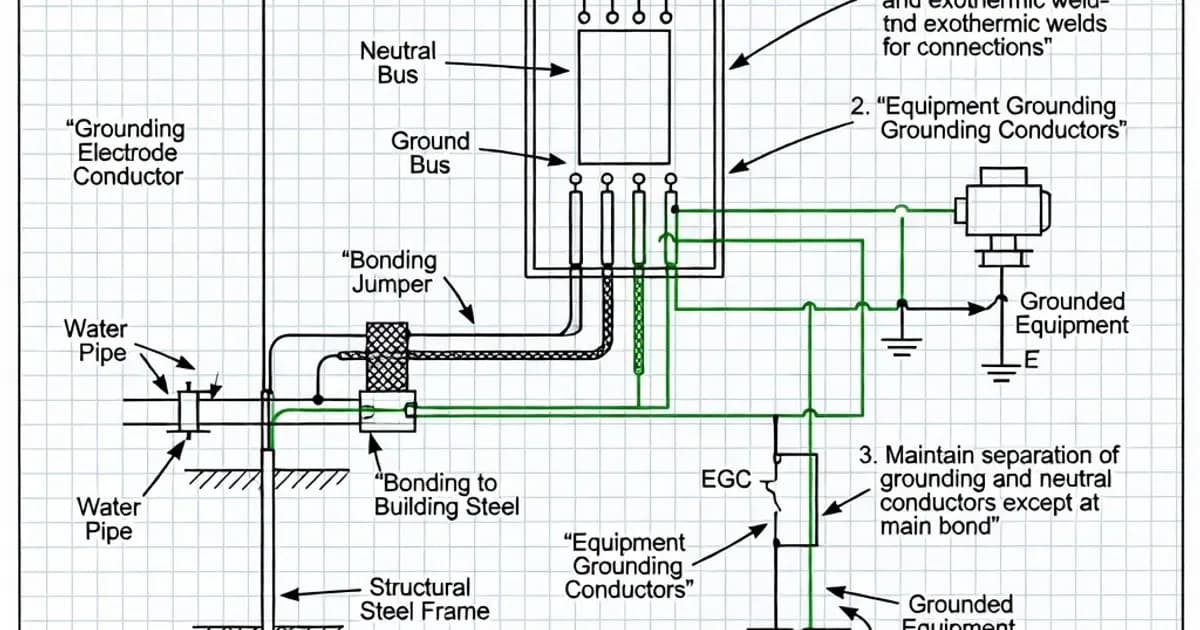
Grounding and Bonding Best Practices
This article outlines best practices for grounding and bonding in electrical systems, emphasizing safety and compliance with industry standards.
Understanding Grounding and Bonding
Grounding refers to connecting electrical systems to the earth, while bonding involves connecting various conductive parts to ensure electrical continuity. Both practices are essential for safety and equipment protection. According to IEEE Std 142-2007, grounding electrode resistance should be 5 ohms or less for industrial facilities to protect sensitive equipment.
Importance of Grounding
Proper grounding helps to:
- Prevent electrical shock hazards.
- Protect equipment from damage due to surges.
- Ensure reliable operation of electrical systems. In 2023, OSHA recorded over 3,000 electrical violations related to inadequate grounding, with average penalties exceeding $14,000 per serious citation.
Grounding Methods
Common grounding methods include:
- Rod Grounding: Using a metal rod driven into the ground. Ground rods must conform to UL 467 and be at least 3/4 inch (20 mm) in diameter made of copper-clad steel.
- Plate Grounding: Using a buried metal plate connected to the system.
- Grounding Rings: A loop of conductive material buried underground to provide a low-resistance path. For dry soil, resistivity ranges from 1,000–10,000 ohm-m, necessitating ground rings with enhancement materials to achieve resistance below 25 ohms.
Bonding Practices
Effective bonding practices include:
- Connecting all metallic parts of electrical equipment to a common grounding point.
- Using appropriate bonding jumpers of sufficient size; for HVAC equipment and building columns, a minimum of 6 AWG copper is recommended.
- Regular inspection and testing of bonded connections, including verifying that exothermic welds join all conductor strands without damage, as per IEEE 837-2014.
Compliance with Standards
Grounding and bonding practices should comply with NEC 250 and IEEE 142 standards to ensure safety and reliability. The minimum grounding-electrode conductor size is 8 AWG copper to guard against electromagnetic interference (EMI) and meet NEC safety requirements.
Conclusion
Implementing grounding and bonding best practices is crucial for electrical safety. Following the guidelines outlined in this article will help create a safer working environment. Additionally, employing exothermic welded connections compliant with IEEE 837-2014 ensures low-impedance connections that enhance safety and reliability.
References & Citations
- IEEE 3003.2-2014 — Recommended practice for equipment grounding and bonding in industrial/commercial power systems, addressing shock hazards and fault current capacity.
- NFPA Resource on NEC Article 250 — Resource covering the basics of grounding and bonding in grounded and ungrounded systems according to NEC Article 250.
- Rockwell Automation Industrial Automation Wiring/Grounding — PDF detailing conductor sizing and EMI reduction best practices for industrial automation wiring and grounding.
- Industry Guide on NEC 250/OSHA Grounding Requirements — Guide providing information on NEC 250 and OSHA grounding requirements, including resistance targets and soil data.
- nVent Technical Document on Grounding/Bonding Systems — Technical document covering IEEE 80/837-compliant welds and materials for grounding and bonding systems.
Need help selecting the right component?
Related Categories
Frequently Asked Questions
Looking for a specific product?
Our team can help you find the right electrical components for your project.