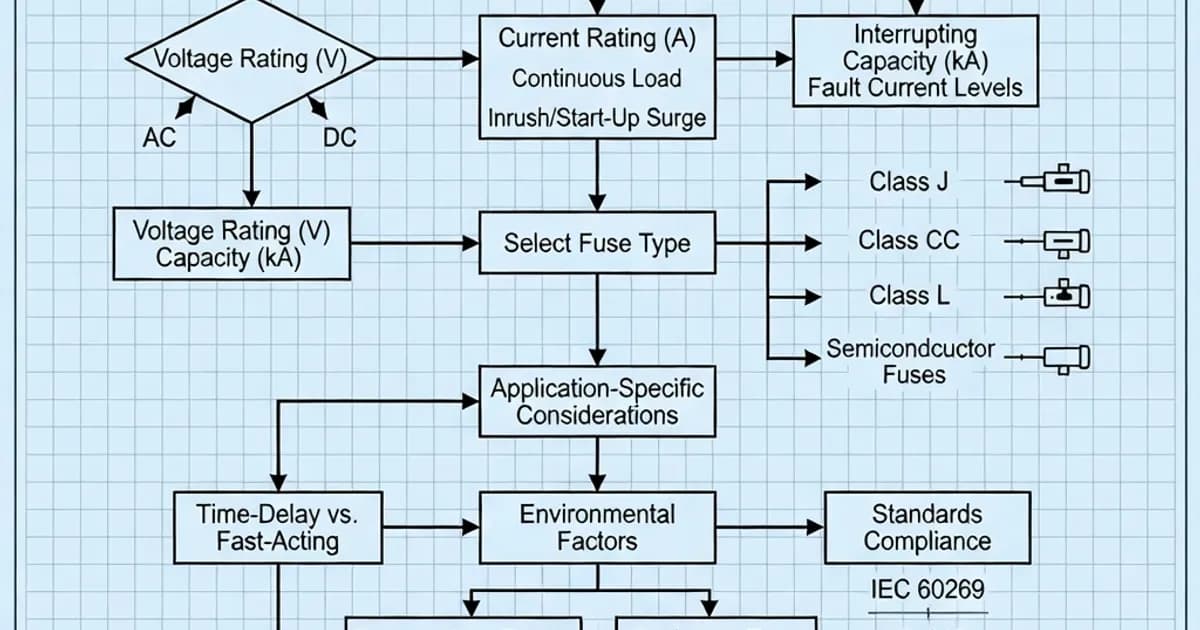
Fuse Selection Guide for Industrial Applications
This comprehensive guide outlines the best practices for selecting fuses in industrial settings. Ensure optimal protection for your electrical systems.
Understanding Fuses
Fuses are critical components in electrical systems, designed to protect circuits from overcurrents. Selecting the right fuse is essential for safeguarding equipment and ensuring system reliability. For optimal performance, the fuse current rating should be selected at 135% of the normal steady-state operating current at 25°C to prevent nuisance blowing.
Types of Fuses
Fuses come in various types, including cartridge, blade, and resettable fuses. Each type has specific applications and advantages, making it essential to choose the right one for your needs. For instance, time-lag fuses are thicker and better suited for motors and capacitors, while quick-acting fuses are ideal for resistive loads like signal lines.
Current Ratings
When selecting a fuse, the current rating must exceed the maximum expected load current while providing adequate protection against overcurrent conditions. Compliance with IEC 60269 standards is crucial. In industrial applications, it is recommended to derate the fuse rating by dividing the operating current by 0.75; for example, if the operating current is 30A, a fuse rated at ≥40A should be selected.
Voltage Ratings
Fuses also have voltage ratings that indicate the maximum voltage they can safely interrupt. Ensure the fuse is rated above the circuit's operational voltage to prevent failure. Standard voltage ratings for small-dimension and midget fuses include 32V, 63V, 125V, 250V, and 600V, and the fuse voltage must equal or exceed the system voltage to extinguish arcs.
Application Considerations
Consider the application environment, load characteristics, and potential fault conditions when selecting a fuse. This ensures optimal performance and compliance with NEC standards. Additionally, it is critical to ensure that the fuse's interrupting rating exceeds the available short-circuit current, which typically ranges from 10kA to 200kA AC in industrial settings.
| Fuse Type | Description |
|---|---|
| Cartridge Fuse | Commonly used in industrial applications, suitable for various power levels. |
| Blade Fuse | Popular in automotive and low-voltage applications, easy to replace and install. |
| Resettable Fuse | Can be reset after tripping, ideal for certain applications where downtime must be minimized. |
Conclusion
Proper fuse selection is vital for protecting electrical systems in industrial settings. By understanding the different types and adhering to relevant standards, such as IEC 60127 and UL 248, you can ensure the safety and reliability of your equipment. Always consider factors like melting I²t and inrush current tolerance to select the most appropriate fuse for your application.
References & Citations
- IEC 60127-6 Standard — Details the requirements for miniature fuse holders, including power, current, and voltage ratings.
- UL 248 Series Standards — Covers the standards for low-voltage fuses, including testing and safety protocols for industrial applications.
- Eaton Fuse Technology Guide — A comprehensive guide on fuse terminology, I²t selection, and criteria for industrial fuse applications.
- Littelfuse Fuseology Guide — Provides selection factors, derating curves, and examples for fuse applications in industrial settings.
- Electrical Engineering Portal: Fuses Guide — An industry guide on fuse selection for industrial systems, including relevant standards and calculations.
Need help selecting the right component?
Related Categories
Frequently Asked Questions
Looking for a specific product?
Our team can help you find the right electrical components for your project.