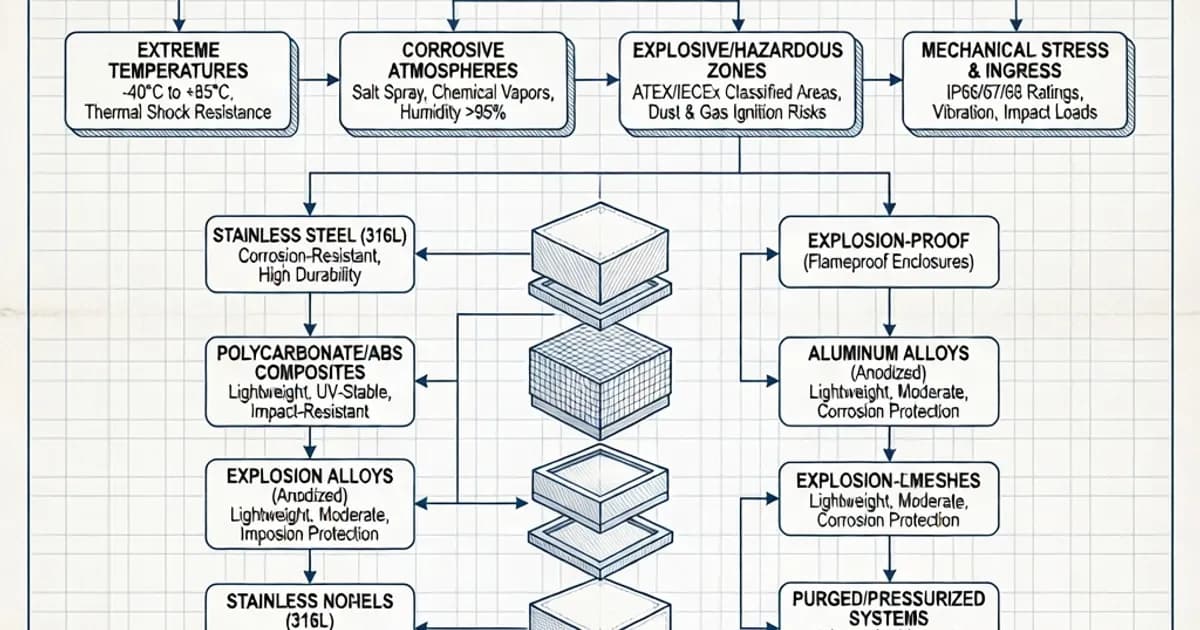
Enclosure Selection Guide for Harsh Environments
This guide provides insight into selecting the right enclosures for harsh environments, focusing on materials, ratings, and application considerations.
Understanding Harsh Environments
Harsh environments can include extreme temperatures, humidity, dust, and corrosive agents. Selecting the right enclosure is critical to protect sensitive electrical components from damage. Enclosures must limit internal temperature rise to <40°C under full load per UL/NEMA tests, especially in ambient temperatures exceeding 40°C.
Material Considerations
The material of the enclosure significantly impacts its performance in harsh conditions:
- Stainless Steel: Excellent corrosion resistance, ideal for chemical environments. Grades 304 and 316 are commonly used, with 316SS offering a pitting resistance equivalent number (PREN) >20, making it suitable for harsh corrosive settings.
- Aluminum: Lightweight and good corrosion resistance; suitable for many applications. Anodized aluminum enclosures can provide a weight savings of 50-60% over steel while maintaining good performance in temperatures ranging from -40°C to +100°C.
- Polycarbonate: Offers impact resistance and is lightweight, suitable for outdoor applications. These enclosures can be combined with IP65 ratings for dust and water protection, making them versatile for various environments.
Ingress Protection (IP) Ratings
IP ratings indicate the enclosure's effectiveness against dust and moisture. A higher rating (e.g., IP66) means better protection: Under IEC 60529, the first digit (0-6) indicates solid particle protection, while the second digit (0-9) denotes liquid ingress protection. For example, IPX6 protects against powerful water jets, while IPX7 allows for temporary immersion up to 1 meter.
| IP Rating | Water Protection | Dust Protection |
|---|---|---|
| IP54 | Protected from splashing water | Limited dust ingress |
| IP66 | Protected from heavy seas or water projected in powerful jets | Completely dust-tight |
Thermal Management
Consider thermal management strategies to prevent overheating:
- Choose enclosures with heat sinks or ventilation options. Ensure that any ventilation does not compromise the IP rating.
- Utilize cooling fans if necessary to regulate internal temperatures. Per UL 50/50E, enclosures should be designed to prevent thermal rise exceeding 30°C above ambient temperature in many types.
Application-Specific Considerations
Different applications may require unique enclosure features:
- Food Processing: Stainless steel with smooth surfaces for easy cleaning. NEMA 4X ratings are recommended for washdown applications, tested against 5% salt spray for durability.
- Marine Applications: High corrosion resistance and UV protection. Stainless steel enclosures (316 grade) are preferred for their durability in marine environments.
Conclusion
Choosing the right enclosure for harsh environments is critical to ensuring the longevity and reliability of electrical components. Consider the factors discussed to make informed decisions, including compliance with relevant standards such as IEC 60529 and NEMA 250, to ensure optimal performance in challenging conditions.
References & Citations
- Electrical Enclosure Ratings Overview — Comprehensive overview of IEC 60529, NEMA 250, UL 50/50E ingress protection and design requirements with rating charts.
- Electrical Enclosures Standards and Ratings Guide — Sierra Pacific guide detailing NEMA 250, UL 50/50E equivalence, common types (e.g., NEMA 4/12), and certification processes.
- Global Comparison of IEC 60529, NEMA 250, UL 50/50E — nVent whitepaper comparing IEC 60529, NEMA 250, UL 50/50E globally, with tables on ingress, design, and testing.
- IP vs. NEMA Ratings for Enclosure Selection — Siemens whitepaper on IP (IEC 60529) vs. NEMA ratings for enclosure selection in electrical equipment.
- IEC vs. UL/NEMA Ratings Comparison — Polycase comparison of IEC IP vs. UL/NEMA ratings, with material and application guidance.
Need help selecting the right component?
Related Categories
Frequently Asked Questions
Looking for a specific product?
Our team can help you find the right electrical components for your project.