DIN Rail Mounting Standards and Best Practices
This article explores the DIN rail mounting standards and best practices to ensure safe and efficient installation of electrical devices. Learn about the types of DIN rails, mounting techniques, and compliance with industry standards.
Introduction to DIN Rail Mounting
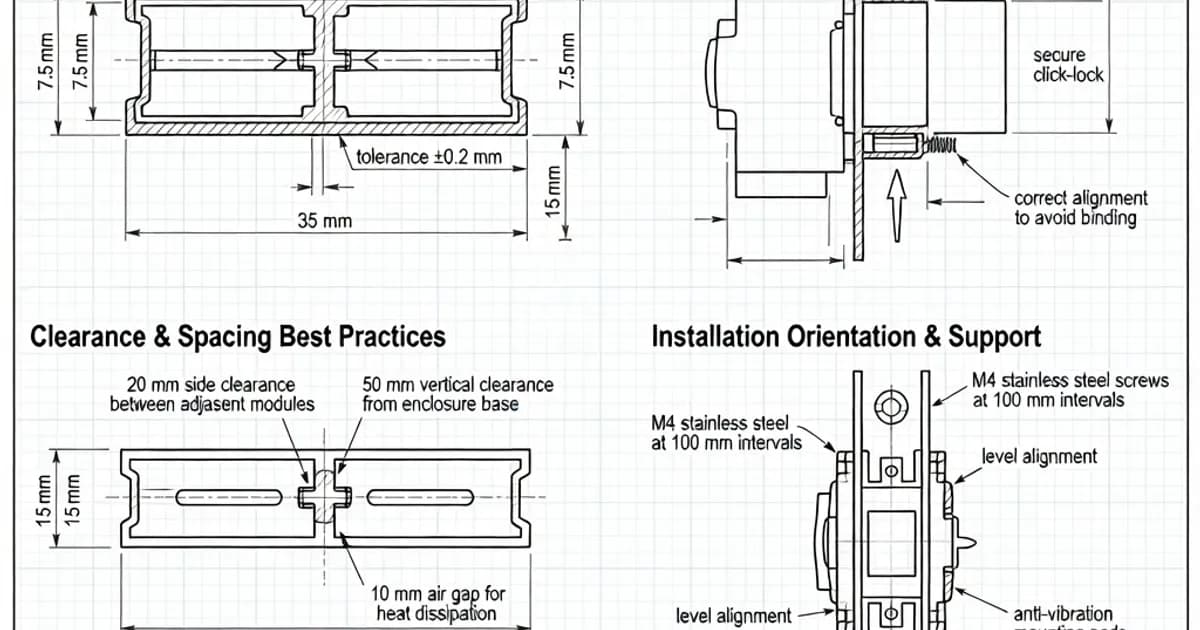
DIN rail mounting is a widely used method for securely attaching electrical devices within enclosures. The Deutsches Institut für Normung (DIN) defines the specifications for these rails, including dimensions and tolerances, ensuring interoperability and standardization across devices. The most common type, the Top Hat DIN rail (EN 50022), measures 35mm in width and can be either 7.5mm or 15mm in height, with thicknesses varying from 1.0mm to 2.2mm for heavy-duty applications.
Types of DIN Rails
There are several types of DIN rails, with the most common being:
- Top Hat Rail (EN 50022): The most common type used for mounting circuit breakers and other devices, typically featuring a module width of 18mm per module.
- G-Profile Rail (EN 50035): Used for larger devices that require more stability, with dimensions including 15mm x 5.5mm for compact applications.
- G-Profile Rail (EN 50045): Suitable for specific applications where space is constrained, offering a miniature profile.
Best Practices for Mounting
To ensure a successful installation, consider the following best practices:
- Ensure proper alignment of the DIN rail to avoid stress on mounted devices. This is especially important for heavy-duty TS35 variants, which can weigh between 1-2 kg/m.
- Use appropriate mounting screws and ensure they are tightened to prevent vibration-related loosening; perforated versions allow for mounting screws up to #10-32 or M5.
- Follow the manufacturer’s specifications for spacing and load capacities, particularly for rails designed for specific weights and applications.
Standards Compliance
Compliance with IEC 60715 and other relevant standards is critical for safety and functionality. These standards provide guidelines for the dimensions and mounting of DIN rails, including the specifications for symmetrical (TS32/TS35) and asymmetrical top-hat DIN rails. Adhering to these standards ensures that installations meet safety regulations and operational requirements.
Installation Tips
Here are some additional tips for effective DIN rail mounting:
- Consider airflow around devices to avoid overheating; this is particularly crucial for densely packed control panels.
- Label all devices clearly for maintenance ease, which can improve troubleshooting efficiency.
- Use end plates to secure devices and prevent them from sliding off the rail, especially in high-vibration environments.
Common Applications
DIN rails are commonly used in various applications, such as:
| Application | Description |
|---|---|
| Control Panels | Used for housing circuit breakers and relays, typically utilizing TS35 rails for their reliability. |
| Automation Systems | Mounting of PLCs and I/O modules, often employing the G-Profile rails for added stability. |
Conclusion
DIN rail mounting is essential for organized and efficient electrical installations. By adhering to standards and following best practices, engineers can ensure reliability and safety in their projects. Utilizing the correct type of DIN rail for the application and following manufacturer recommendations can significantly enhance installation quality and longevity.
References & Citations
- IEC 60715: Dimensions for DIN rails — Official IEC standard page for international specifications regarding DIN rail dimensions.
- Altech Corp DIN Rail Catalog — Detailed dimensions, materials, and custom options for various DIN rails from Altech Corporation.
- AutomationDirect DIN Rails Spec Sheet — Engineering drawings, materials, and mounting guidelines for DIN rails provided by AutomationDirect.
- ITC Electrical Components Catalog — Catalog detailing TS35/TS32 profiles, weights, and relevant EN/DIN standards from ITC Electrical Components.
- Electrical Engineering Portal: DIN Rail Guide — Industry guide on DIN rail types and applications, including an overview of relevant standards.
Need help selecting the right component?
Related Categories
Frequently Asked Questions
Looking for a specific product?
Our team can help you find the right electrical components for your project.