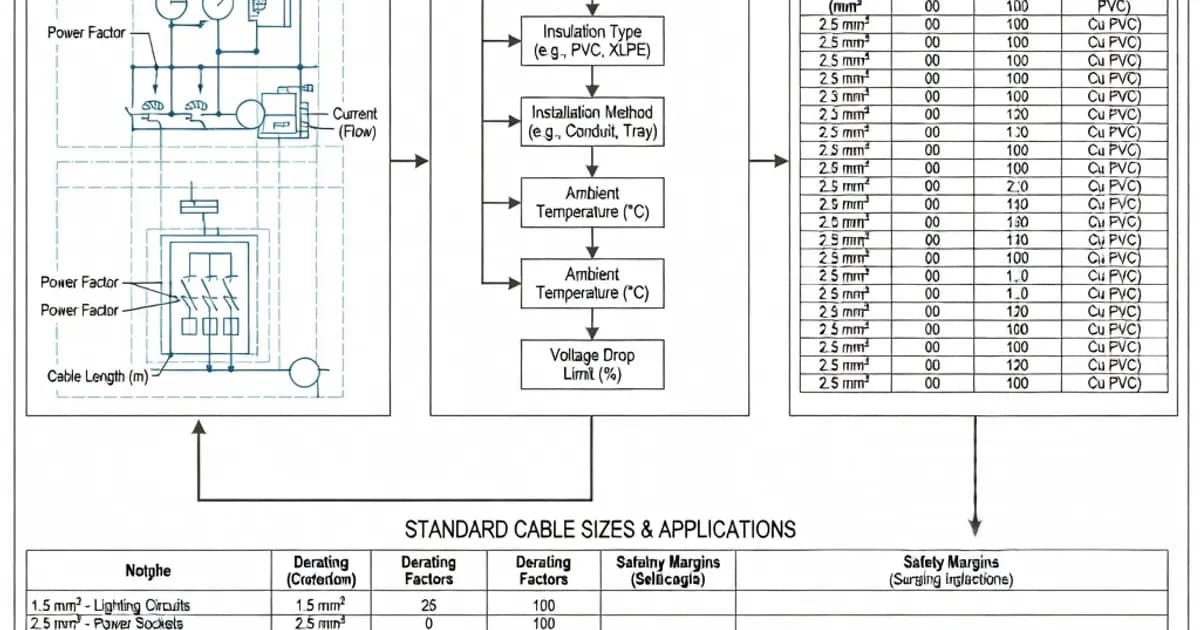
Cable Sizing Guide for Electrical Installations
This guide provides essential information on cable sizing for electrical installations based on current carrying capacity, voltage drop, and installation conditions.
Introduction to Cable Sizing
Cable sizing is a critical aspect of electrical installations, ensuring safety and performance by selecting cables that can handle the required load. Proper sizing minimizes heat generation and voltage drop. This guide will cover key factors and calculations involved in cable sizing. It is essential to consider standards such as IEC 60364-5-52 for low-voltage installations and NEC 310 for ampacity tables to ensure compliance with safety regulations.
Current Carrying Capacity
The first step in cable sizing is determining the current carrying capacity (ampacity) of the cable. According to the NEC 310 standard, ampacity depends on the conductor material (copper or aluminum), insulation type, and installation conditions. For example, common copper cable ratings include 1.5 mm² (18A), 2.5 mm² (24A), and larger sizes up to 25 mm² for industrial applications. Additionally, the ampacity must satisfy the short-circuit withstand requirements, which can be calculated using the formula: S = \frac{I_{sc} \sqrt{t}}{K}, where I_{sc} is the fault current (A), t is the fault duration (s), and K is the material factor.
Voltage Drop Considerations
Voltage drop is another critical factor in cable sizing. Excessive voltage drop can lead to reduced efficiency and equipment malfunction. The acceptable voltage drop in most installations is between 3-5%. The formula for calculating voltage drop is:
Voltage Drop (V) = (2 * Length * Current * Resistance) / 1000To ensure compliance, the voltage drop index (VDI) can be calculated using the formula: VDI = \frac{Amps \times Feet}{\%VoltDrop \times Voltage}. For instance, an AWG 6 copper conductor has an ampacity of 75A and a VDI of 12, making it suitable for various applications.
Table of Cable Sizing Parameters
| Parameter | Description |
|---|---|
| Ampacity | Current carrying capacity of the cable, which varies by size and material; for example, 1.5 mm² copper is rated for 18A. |
| Voltage Drop | Loss of voltage over distance; typically limited to 3-5% to maintain efficiency. |
| Conductor Material | Type of metal used (copper or aluminum); copper has higher conductivity and is often preferred for lower resistance. |
| Insulation Type | Type of insulation material used; XLPE is recommended for industrial applications due to its thermal properties. |
| Installation Conditions | Environment where the cable is installed; correction factors must be applied for ambient temperature and grouping according to IEC 60364-5-52. |
Conclusion
Selecting the appropriate cable size is essential for ensuring safety and efficiency in electrical installations. By considering ampacity, voltage drop, and installation conditions, engineers can make informed decisions on cable selection. Additionally, utilizing manufacturer recommendations and online calculators can aid in achieving compliance with relevant standards and optimizing performance.
References & Citations
- IEC 60364-5-52 — Authoritative standard for low-voltage electrical installations, covering cable sizing, current-carrying capacity, and correction factors.
- NEC/NFPA 70 Article 310 — US ampacity tables and conductor sizing guidelines for general electrical installations.
- Understanding Wire and Cable Sizing in Medium Voltage Electrical Systems — Practical guidance on medium-voltage cable sizing according to NEC and UL standards.
- Schneider Electric Cable Size Calculator — Resource for cable size charts, calculators, and selection factors for industrial low-voltage applications.
- ELEK Software Cable Sizing Calculator — Free IEC 60364-5-52 compliant calculator with detailed procedures and tables for cable sizing.
Need help selecting the right component?
Related Categories
Frequently Asked Questions
Looking for a specific product?
Our team can help you find the right electrical components for your project.